
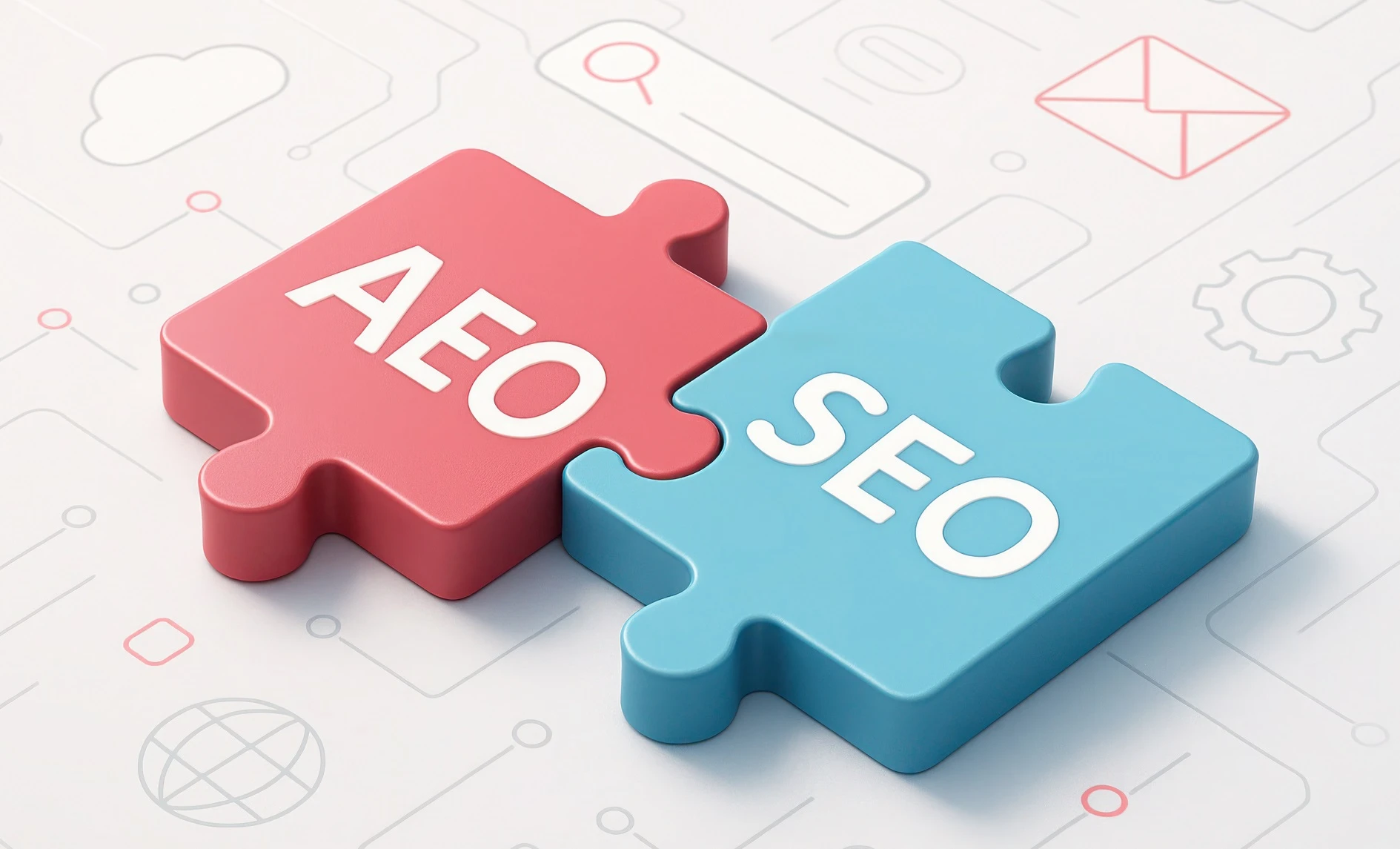
SEO, AEO, and GEO describe different ways of thinking about search visibility, but businesses should not treat them as three completely separate marketing systems.
SEO, or Search Engine Optimization, focuses on making websites discoverable, understandable, indexable, relevant, and competitive in search results.
AEO, or Answer Engine Optimization, is commonly used to describe optimizing information so search and answer systems can identify a useful direct answer.
GEO, or Generative Engine Optimization, focuses more specifically on visibility inside responses created by generative AI systems, including citations, source selection, brand mentions, and recommendations.
The boundaries are not universally standardized.
More importantly, Google now explicitly states that AEO and GEO are terms used for improving AI-search visibility, but from Google Search’s perspective, optimizing for generative AI search is still part of SEO.
The right question for most businesses is therefore not:
Should we choose SEO, AEO, or GEO?
It is:
How do we build one search visibility strategy that works across traditional search results, direct-answer experiences, and generative AI discovery?
SEO vs AEO vs GEO at a Glance
Area | SEO | AEO | GEO |
Full name | Search Engine Optimization | Answer Engine Optimization | Generative Engine Optimization |
Main objective | Earn visibility in search results | Make information suitable for direct answers | Improve visibility inside generated AI responses |
Typical outcome | Ranked organic result | Extracted or synthesized answer | Citation, mention, recommendation, or source inclusion |
Typical surfaces | Google Search, Bing | Featured answers, voice/search answers, AI answer interfaces | ChatGPT, Gemini, Perplexity, Copilot, Google generative experiences |
Primary optimization unit | Page and website | Answer or passage within a page | Page, passage, brand, entity, and supporting evidence |
Main measurement | Rankings, impressions, clicks, organic conversions | Answer visibility and answer inclusion | AI citations, mentions, source visibility, prompt/topic share |
Technical foundation | Crawlability, indexability, architecture | Usually depends on the same foundation | Usually depends on the same foundation |
Content requirement | Relevant and useful content | Clear and direct answers | Clear information, evidence, entity context, and source credibility |
Replaces SEO? | No | No | No |
The important distinction is not that each column needs its own website strategy.
The distinction is where success appears.
What Is SEO?
Search Engine Optimization is the process of improving a website’s ability to earn relevant organic visibility through search engines.
SEO can involve:
- Crawlability and indexability
- Website architecture
- Technical SEO
- Search intent
- Keyword research
- On-page optimization
- Content quality
- Internal linking
- Topical coverage
- Backlinks and digital authority
- Structured data
- Local SEO
- Ecommerce SEO
- Page experience
- Conversion paths
- Performance measurement
The objective is not simply to rank for keywords.
Effective SEO connects a search query to the right page and then helps the visitor complete a meaningful next step.
Pro Branding’s SEO services already treat search visibility as a system that connects technical performance, content, internal linking, authority, local search, AI-powered discovery, and conversion rather than treating ranking as an isolated objective.
What Does SEO Success Look Like?
Traditional SEO performance can be measured through signals such as:
- Organic impressions
- Organic clicks
- Search rankings
- Non-branded visibility
- Organic landing-page traffic
- Qualified organic leads
- Organic sales
- Calls
- Bookings
- Form submissions
- Revenue influenced by organic search
The exact measurement should follow the business objective.
Ranking number one for a high-volume informational keyword may be less valuable than ranking fifth for a commercial query that consistently generates qualified customers.
What Is AEO?
AEO stands for Answer Engine Optimization.
The term is generally used to describe making information easy for systems to understand and use when providing a direct answer to a question.
AEO became useful as search experiences moved beyond lists of links and began answering more questions directly through formats such as:
- Featured answers
- Voice search
- Question-and-answer interfaces
- Search assistants
- AI-generated search responses
An AEO-oriented section normally answers the question quickly and then provides enough explanation to make the answer useful.
For example:
Weak:
There are many factors businesses should consider when thinking about SEO pricing.
Clearer:
SEO cost depends on the website’s current condition, competition, target market, project scope, content requirements, technical work, and authority-building needs.
The second answer establishes the relationship immediately.
That clarity helps the reader even before any search-engine benefit is considered.
Does AEO Require a Special Content Format?
No universal format exists.
Some marketers recommend exact answer lengths, mandatory question headings, specific numbers of FAQs, or small predefined content blocks.
Those can sometimes improve readability, but they should not be treated as requirements.
Google’s current generative-search guidance specifically says that websites do not need to break content into artificial small chunks or rewrite pages in a special format just for AI systems. Google recommends organizing information for users rather than following artificial AI-content rules.
A better AEO principle is:
Answer the question clearly enough that the answer can stand on its own, then provide the context necessary to make it useful.
What Is GEO?
GEO stands for Generative Engine Optimization.
The term was formalized in academic research published by researchers including Pranjal Aggarwal, Vishvak Murahari, Tanmay Rajpurohit, Ashwin Kalyan, Karthik Narasimhan, and Ameet Deshpande.
Their work described Generative Engine Optimization as an optimization framework for improving the visibility of content inside responses produced by generative engines. The research was presented in the KDD 2024 proceedings.
The key difference from traditional search is the output.
A traditional search result may show a list of webpages.
A generative engine may retrieve information from several sources, combine that information, and generate a new response.
That means a business may care about questions such as:
- Was our website used as a source?
- Was our brand mentioned?
- Was our page cited?
- Was our product included in a comparison?
- Was our company associated with the right category?
- Was a competitor recommended instead?
- Which sources influenced the answer?
These are different measurements from a normal keyword ranking.
GEO Is Not a Guaranteed Citation Technique
No optimization method can guarantee that ChatGPT, Google AI Mode, Gemini, Copilot, Perplexity, or another generative system will cite a specific page.
Retrieval systems change.
Prompts change.
Available sources change.
Models and ranking systems change.
Google explicitly states that meeting all technical requirements and best practices does not guarantee crawling, indexing, or inclusion in its generative AI experiences.
OpenAI likewise states that public websites can be eligible to appear in ChatGPT Search, but placement is not guaranteed. For content to be discoverable for ChatGPT Search, publishers should ensure that OAI-SearchBot is not blocked where appropriate.
GEO should therefore be treated as visibility optimization, not citation manipulation.
Is There Really a Clear Difference Between AEO and GEO?
Not always.
This is one of the biggest sources of confusion in AI-search marketing.
Different practitioners use the terms differently.
One common model is:
AEO = optimizing content to produce direct answers.
GEO = optimizing content to appear within generated AI answers.
Another model treats GEO as a subset of AEO.
Another treats AEO and GEO as different names for nearly the same emerging discipline.
Google now groups both terms together when discussing third-party terminology for AI-search optimization and states that, within Google Search, this work remains part of SEO.
For businesses, the practical distinction is more useful than the terminology.
Use:
SEO when discussing search visibility as a whole.
AEO when focusing specifically on answer clarity and answer-level retrieval.
GEO when focusing specifically on visibility, citations, mentions, and recommendations inside generative AI systems.
Then build them through one connected strategy.
Does GEO Replace SEO?
No.
For Google Search specifically, Google says traditional SEO best practices remain relevant to AI Overviews and AI Mode because its generative experiences use core Search ranking and quality systems.
Google’s generative-search systems can use retrieval-augmented generation and query fan-out to retrieve relevant information from the Search index before generating an answer.
For a page to be eligible as a supporting link in Google’s generative AI features, Google says the page must already be indexed and eligible to appear in Search with a snippet.
Bing makes a similar point.
Its webmaster guidance says Microsoft search and Copilot experiences rely on the same fundamental crawling, indexing, and search foundations used by traditional search.
So if a website has serious problems with:
- Crawlability
- Indexability
- Duplicate URLs
- Canonicals
- Site architecture
- Weak content
- Poor internal linking
- Thin service pages
- Unclear entities
- Weak authority
adding “GEO optimization” on top will not remove those problems.
That is why Pro Branding’s AI search content optimization approach builds on SEO fundamentals rather than treating AI visibility as a replacement for them.
How SEO, AEO, and GEO Work Together
A useful way to think about the relationship is as one visibility system with different outputs.
Layer 1: Technical Discovery
Search and AI retrieval systems need access to the information.
That can involve:
- Crawlable pages
- Correct indexation
- Clean canonical signals
- Logical site architecture
- Useful internal links
- Accessible text
- Fast and usable pages
Without this layer, everything above it becomes less reliable.
Layer 2: Search Intent and Topic Relevance
The page needs to satisfy a real information need.
This requires:
- Correct intent
- Clear page purpose
- Useful topic coverage
- Strong relationships between related concepts
- Appropriate internal links
- Distinct page ownership
Pro Branding’s topical authority strategy guide explains how pillar pages and focused supporting content can create a clearer subject architecture without publishing multiple pages for the same intent.
Layer 3: Answer Clarity
Important questions should receive direct, understandable answers.
A reader should not need to read five paragraphs before finding a definition.
This is the part of the process most commonly associated with AEO.
Layer 4: Entity Clarity
Search and generative systems need clear context around entities and their relationships.
For a business, this can include:
Brand
→ category
→ services
→ locations
→ audience
→ problems solved
→ products
→ expertise
Pro Branding’s entity-based SEO optimization guide explains why connected entity relationships provide more useful meaning than disconnected keyword targeting.
Layer 5: Evidence and Authority
Generative systems often need information they can confidently ground a response in.
Useful content may include:
- Primary sources
- Original research
- Expert explanation
- Documented methodology
- Product specifications
- First-party information
- Case evidence
- Clear sourcing
- Current factual information
Google’s July 2026 guidance emphasizes creating non-commodity content that offers original expertise or experience rather than recycling material already available across the web.
Layer 6: Generative Visibility
At this layer, the question becomes:
Is the brand or page being retrieved, cited, referenced, or recommended for the prompts that matter?
That is the area most commonly described as GEO.
Example: SEO vs AEO vs GEO for One Business
Imagine a software company selling CRM software.
SEO Goal
Rank an appropriate commercial page for:
CRM software for real estate companies
The page needs strong search intent, technical accessibility, useful product information, authority, and a clear conversion path.
AEO Goal
Become a useful answer source for:
What should a real estate CRM include?
A page could clearly explain features such as lead tracking, property matching, pipeline management, follow-ups, integrations, and reporting.
GEO Goal
Build enough relevant information and authority to be considered when someone asks:
What CRM platforms should a property developer compare for a multi-project sales team?
The answer may combine several sources and recommendations.
The business is not creating three disconnected websites.
It is building a sufficiently strong information system to be discoverable across different search experiences.
What Actually Changes When Optimizing for GEO?
The SEO foundation stays.
The emphasis changes.
Search Becomes More Conversational
Traditional keyword research may identify:
SEO agency Dubai
Generative-search research might also investigate questions such as:
Which SEO agency can support a company entering Dubai and Saudi Arabia?
or:
What should I compare when choosing an SEO and GEO agency for a bilingual website?
These are not necessarily separate pages.
They reveal additional information needs that the existing content architecture may need to satisfy.
Passage-Level Clarity Matters More Operationally
A long page may answer many different questions.
Important sections should therefore make sense independently.
Instead of:
It is useful because it improves visibility.
Write:
Structured data helps search engines identify specific information and entities on a page, but Google does not require special structured data for inclusion in AI Overviews or AI Mode.
That passage contains the entity, relationship, context, and answer.
Brand Context Matters
A generative system may need to determine more than whether one page is relevant.
It may need to understand:
- What the company does
- Which markets it serves
- Which category it belongs to
- What evidence exists
- What other sources say about it
That makes brand consistency and entity clarity increasingly important.
Citations and Mentions Become Additional Outcomes
Traditional search measurement asks:
Did we rank and get the click?
GEO measurement can additionally ask:
Were we used as a source?
Were we cited?
Were we mentioned?
For which topics?
Which competitors appeared instead?
This is one of the clearest operational differences.
How Should SEO, AEO, and GEO Be Measured?
Do not force all three into one KPI.
SEO Metrics
Track:
- Organic clicks
- Organic impressions
- Rankings
- CTR
- Landing-page traffic
- Organic conversions
- Qualified leads
- Revenue where attribution is available
AEO Metrics
Depending on the search surface, useful measurements can include:
- Featured-answer visibility
- Direct-answer inclusion
- Question-level visibility
- Search-feature presence
- AI-answer appearances
AEO measurement is less standardized than traditional rank tracking.
GEO Metrics
Useful metrics can include:
- AI citations
- Cited URLs
- Brand mentions
- Competitor mentions
- Prompt or topic visibility
- Citation share
- Referral traffic from AI platforms
- Conversions influenced by AI discovery
Measurement capabilities are improving quickly.
Bing Webmaster Tools introduced AI Performance reporting in 2026, allowing publishers to review how their content is cited across Microsoft Copilot, AI-generated Bing summaries, and supported partner experiences.
Google’s current Search Central guidance also directs site owners to a Generative AI performance report in Search Console for monitoring discovery through Google’s generative AI features.
OpenAI provides publisher guidance for making public content eligible for ChatGPT Search discovery, while making clear that placement is not guaranteed.
The measurement landscape is therefore becoming more concrete, but it is still less mature and standardized than conventional SEO reporting.
Do You Need a Special Schema for GEO or AEO?
No special Google schema exists for GEO or AEO.
Google explicitly says there is no special Schema.org markup required to appear in AI Overviews or AI Mode.
Structured data remains useful when it accurately describes visible page content and supports existing search features, but it should not be treated as an AI-visibility shortcut.
Pro Branding covers the appropriate role of schema in its structured data and AI visibility guide, including why schema should support strong content rather than compensate for weak pages.
Do You Need an llms.txt File for GEO?
Not for Google Search.
Google’s July 2026 guidance explicitly says Google Search does not use llms.txt files as a special visibility mechanism and that adding one neither helps nor hurts Google Search rankings or generative-search visibility.
Other services may choose to support different files or protocols, so the answer can differ by platform.
The broader rule is:
Do not build an AI-search strategy around technical files that the target system does not officially say it uses.
Should You Write Separate SEO, AEO, and GEO Content?
Usually not.
Publishing one SEO article, another AEO article, and another GEO article targeting essentially the same question can create:
- Duplicate intent
- Keyword cannibalization
- Content maintenance problems
- Diluted internal authority
- Repetitive pages
- Poor user experience
One strong page can often support all three objectives.
Ask:
SEO: Can the page be discovered, indexed, understood, and ranked?
AEO: Does the page clearly answer the user’s question?
GEO: Does the page provide enough context, evidence, and entity clarity to be useful inside a generated response?
If all three answers are yes, the same content asset may support all three discovery environments.
SEO vs AEO vs GEO: Which Should Your Business Prioritize?
For most businesses, the correct order is not to choose one acronym and ignore the others.
Start With SEO Foundations If:
- Important pages are not indexed.
- Organic visibility is weak.
- Site architecture is unclear.
- Service pages do not match search intent.
- Technical issues exist.
- Content is thin or duplicated.
- Internal linking is weak.
- The website has little authority.
GEO tactics cannot compensate for a website that search systems struggle to access or understand.
Add Stronger Answer Optimization If:
- The website already ranks for informational queries.
- Customers repeatedly ask specific questions.
- Content contains long introductions before useful answers.
- Definitions and processes are difficult to extract.
- The company publishes documentation, guides, educational content, or support material.
Expand AI Visibility Measurement If:
- Buyers increasingly use ChatGPT, Gemini, Perplexity, Copilot, or Google generative search during research.
- Competitors appear in AI recommendations but your brand does not.
- The business operates in a research-heavy B2B category.
- Buyers compare multiple vendors before contacting sales.
- You need visibility beyond traditional keyword rankings.
The strongest strategy may therefore be:
SEO foundation → clearer answers → stronger entity/evidence signals → generative visibility measurement
not three separate marketing programs.
How to Evaluate an SEO, AEO, or GEO Agency
Do not choose an agency because it added more AI acronyms to its service page.
Ask what actually changes in the work.
Ask How They Handle Technical Discovery
A credible strategy should still address crawling, indexation, architecture, canonicalization, internal linking, page experience, and technical accessibility.
Ask How They Research AI Discovery
The agency should be able to explain how conversational queries and buyer prompts differ from traditional keyword tracking without proposing hundreds of duplicate pages.
Ask How They Improve Content
Look for methods involving:
- Intent
- Answer clarity
- Topic coverage
- First-party expertise
- Evidence
- Entity relationships
- Internal links
- Conversion paths
Be cautious of rigid formulas claiming every page needs an exact number of words, citations, FAQs, or answer blocks.

Ask How They Measure GEO
A provider selling GEO should be able to explain how it evaluates:
- AI citations
- Brand mentions
- Competitor inclusion
- Topic visibility
- Referral traffic
- Business impact
If the only report is still a traditional keyword ranking report, the GEO layer may exist only in the sales presentation.
Ask What They Can Guarantee
Nobody can guarantee a Google ranking, AI Overview citation, ChatGPT recommendation, or Gemini mention.
Platforms decide which sources are retrieved and displayed.
Optimization can improve eligibility, relevance, clarity, authority, and visibility.
It cannot control the final answer.
What Pro Branding’s Approach Looks Like
Pro Branding treats traditional and AI search visibility as connected parts of one digital authority system.
Its verified SEO offering includes technical SEO, on-page SEO, content SEO, local SEO, topical authority, internal linking, structured data, entity coverage, digital PR, analytics, and visibility in AI-powered search experiences.
That same architecture supports Pro Branding’s existing guidance on optimizing content for AI search engines and building citation potential in ChatGPT and Google AI experiences.
The objective is not to replace SEO with a new acronym.
It is to make a business easier to discover, understand, evaluate, and trust wherever modern search happens.
If your company is already investing in SEO but you are unsure whether your website is prepared for AI-driven discovery, Pro Branding can review the technical foundation, search demand, content architecture, entity signals, AI visibility, and conversion path before deciding what should change.
You can contact Pro Branding for an SEO and AI-search strategy review.
4. FAQ
Is AEO the same as GEO?
Not exactly, but the terms overlap heavily and there is no universally standardized industry boundary between them. AEO generally emphasizes making content suitable for direct answers, while GEO focuses more specifically on visibility inside generated AI responses, including citations and mentions. Google groups both terms under work focused on AI-search visibility and considers that work part of SEO for Google Search.
Is GEO replacing SEO?
No. Google’s generative AI search experiences use core Search ranking and quality systems, and Google explicitly says foundational SEO practices remain relevant. Bing also states that its AI experiences rely on the same fundamental crawling and indexing foundations as traditional search.
What is the main difference between SEO and GEO?
SEO traditionally measures visibility through rankings, impressions, clicks, and organic conversions. GEO adds another visibility layer: whether a brand or website is retrieved, cited, mentioned, or recommended within a generative AI response.
What is the main difference between AEO and SEO?
SEO addresses the broader process of organic search visibility, while AEO focuses more narrowly on making information clear and suitable for direct answers. Strong AEO normally depends on SEO foundations such as crawlability, indexation, relevance, content quality, and website architecture.
Does Google recognize AEO and GEO?
Google recognizes AEO and GEO as terms used by the industry for work focused on visibility in AI search experiences. Google’s official position is that optimizing for generative AI experiences within Google Search remains part of SEO rather than requiring a separate optimization discipline.
Can GEO get my company mentioned by ChatGPT?
GEO can improve the quality, clarity, accessibility, and authority of information available about a company, but it cannot guarantee a ChatGPT mention. OpenAI says public websites can appear in ChatGPT Search when eligible and accessible, but placement is not guaranteed.
Does structured data improve AI citations?
Structured data can help search engines understand page information and support eligible traditional search features, but Google says no special structured data is required for AI Overviews or AI Mode. Schema should support accurate visible content rather than be treated as an AI-citation shortcut.
How do you measure GEO performance?
GEO can be measured through AI citations, cited URLs, brand mentions, competitor mentions, prompt or topic visibility, AI referral traffic, and conversions influenced by AI discovery. Bing now provides AI citation reporting through Bing Webmaster Tools, while Google has introduced generative AI performance reporting through Search Console.
Should a business hire separate SEO and GEO agencies?
Usually not unless there is a clear operational reason. SEO and GEO share core requirements such as technical accessibility, relevant content, site structure, authority, and accurate information. Businesses should evaluate the actual work and measurement model rather than paying separately because the terminology is different.
Which should I invest in first: SEO, AEO, or GEO?
Start with SEO fundamentals if your website has technical, indexing, architecture, content, or authority problems. Then improve answer clarity and expand generative-search visibility and measurement. Established websites can often work on all three simultaneously because much of the underlying work overlaps.