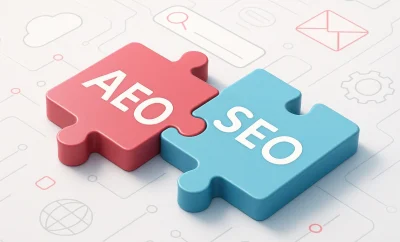

Search is changing. People no longer rely only on traditional search results. They ask longer questions, expect direct answers, compare options faster, and increasingly receive AI-generated summaries before visiting a website.
This does not mean SEO is dead. It means content needs to become clearer, more structured, more trustworthy, and easier for AI search engines to understand.
For businesses in Egypt and the Gulf, this shift is important. Markets are becoming more competitive, and brands that still write generic SEO content may lose visibility to brands that provide stronger answers, clearer expertise, and better information structure.
What Does AI Search Optimization Mean?
AI search optimization is the process of creating content that can be understood, summarized, and trusted by search engines and AI-powered answer systems.
Google explains that SEO best practices still matter for generative AI search because AI features in Search are connected to Google’s core ranking and quality systems. In other words, brands should not abandon SEO. They should improve it.
Traditional SEO focused heavily on keywords, rankings, backlinks, and technical performance. These are still important, but AI search adds another layer: the content must be useful enough to be selected, summarized, and cited as part of an answer.

Why AI Search Engines Need Clearer Content
AI search engines do not read content like humans. They process structure, entities, context, relationships, headings, and clarity.
If your content is vague, repetitive, or written only to target keywords, it becomes harder to understand. If your content clearly explains the topic, answers specific questions, and connects related concepts, it becomes more useful for both users and AI systems.
This is why modern content should be built around meaning, not only keywords.
Start with Search Intent, Not Keywords Only
Keywords are still useful, but they are not enough.
A keyword tells you what people search for. Search intent tells you what they actually need.
For example, someone searching for “best branding agency in Egypt” may want comparison, credibility, services, pricing logic, case studies, or proof of expertise. If your content only repeats the keyword without answering the decision behind it, it will feel weak.
To optimize for AI search engines, every page should answer:
- What is the user trying to understand?
- What decision are they trying to make?
- What information would make the answer complete?
- What related questions should be covered?
Content that satisfies the full intent has a better chance of being useful in AI-driven search experiences.
Build Content Around Entities
AI search engines understand topics through entities and relationships.
An entity can be a brand, service, location, industry, person, product, or concept. For example, in a branding article, important entities may include brand strategy, positioning, value proposition, visual identity, messaging, customer perception, and market differentiation.
Instead of writing isolated paragraphs, connect these ideas together. This helps search engines understand that your brand has topical depth.
For ProBranding, this means content should not only target “marketing agency.” It should connect related entities such as brand strategy, content marketing, performance marketing, SEO, media production, website development, lead generation, and conversion strategy.
That is how a website starts building stronger topical authority.
Use Clear Headings and Logical Structure
AI search engines need structure.
Strong headings help both users and search systems understand what each section covers. A good page should move logically from definition to explanation, then practical steps, examples, and final recommendation.
Avoid large blocks of text with unclear flow. Use H2 and H3 headings that reflect real questions or clear subtopics.
For example:
- What Is AI Search Optimization?
- How Do AI Search Engines Understand Content?
- How to Structure Content for AI Visibility
- Common Mistakes to Avoid
This makes the content easier to scan, extract, and summarize.
Write Direct Answers Before Detailed Explanations
AI search often rewards clarity.
When answering a question, start with a direct explanation, then expand with details. Do not hide the answer under long introductions.
For example:
Weak:
“In today’s digital world, many businesses are trying to understand the new landscape of online visibility…”
Stronger:
“AI search optimization means creating content that is clear, structured, trustworthy, and easy for AI-powered search systems to understand and summarize.”
The second version is better because it gives immediate value.
Create Helpful, People-First Content
Google’s guidance emphasizes helpful, reliable, people-first content created to benefit users, not content made mainly to manipulate rankings.
This point matters more with AI search. Thin content, copied summaries, and generic articles are easier to ignore. Strong content should include original thinking, practical examples, expert insight, and information that helps the user make a decision.
For businesses in Egypt and the Gulf, this is a major opportunity. Many competitors still publish basic content. A brand that explains topics clearly and shows real market understanding can stand out faster.
Add Structured Data and Schema
Structured data helps search engines understand page content more clearly. Google states that structured data can help it understand the content of a page and gather information about entities mentioned in the markup.
For AI visibility, schema can support better interpretation of your content, especially for pages such as:
- Articles.
- Services.
- FAQs.
- Organizations.
- Local businesses.
- Products.
- Reviews.
- Events.
Structured data does not guarantee visibility, but it makes the page easier to understand technically.
Strengthen Trust Signals
AI search engines need to trust the source before using it.
Trust signals may include:
- Clear author or company information.
- Real case studies.
- Service pages with specific details.
- Updated content.
- Internal links to related topics.
- Contact information.
- Client portfolio.
- Industry experience.
For a marketing company, this is especially important. If your website claims expertise in branding, SEO, PPC, and content strategy, your content should prove that expertise through depth, clarity, and examples.
Build Topic Clusters, Not Random Articles
One article is not enough to build AI search visibility.
Brands should build connected content clusters around major topics. For example, a branding cluster may include positioning, value proposition, brand voice, brand identity systems, brand guidelines, and rebranding strategy.
An SEO cluster may include topical authority, entity-based SEO, schema, AI search visibility, internal linking, and content optimization.
This helps search engines understand that your website is not covering a topic randomly. It has depth.

How ProBranding Approaches AI Search Optimization
At ProBranding, AI search optimization is not treated as a trick. It is treated as a smarter content system.
The process connects SEO strategy, entity mapping, content structure, brand authority, technical optimization, schema, and conversion-focused writing. The goal is not only to rank, but to make the brand easier to discover, understand, trust, and choose.
For companies in Egypt and the Gulf, this approach can help turn content from simple blog publishing into a real visibility and lead-generation asset.
Final Thoughts
AI search engines are changing how people discover information, but the winning principle is still clear: useful content wins.
Brands that want stronger visibility need to write with clarity, structure, expertise, and purpose. They need to answer real questions, build topical authority, support trust, and make their pages easier for both humans and AI systems to understand.
AI search does not reduce the need for good content. It raises the standard.